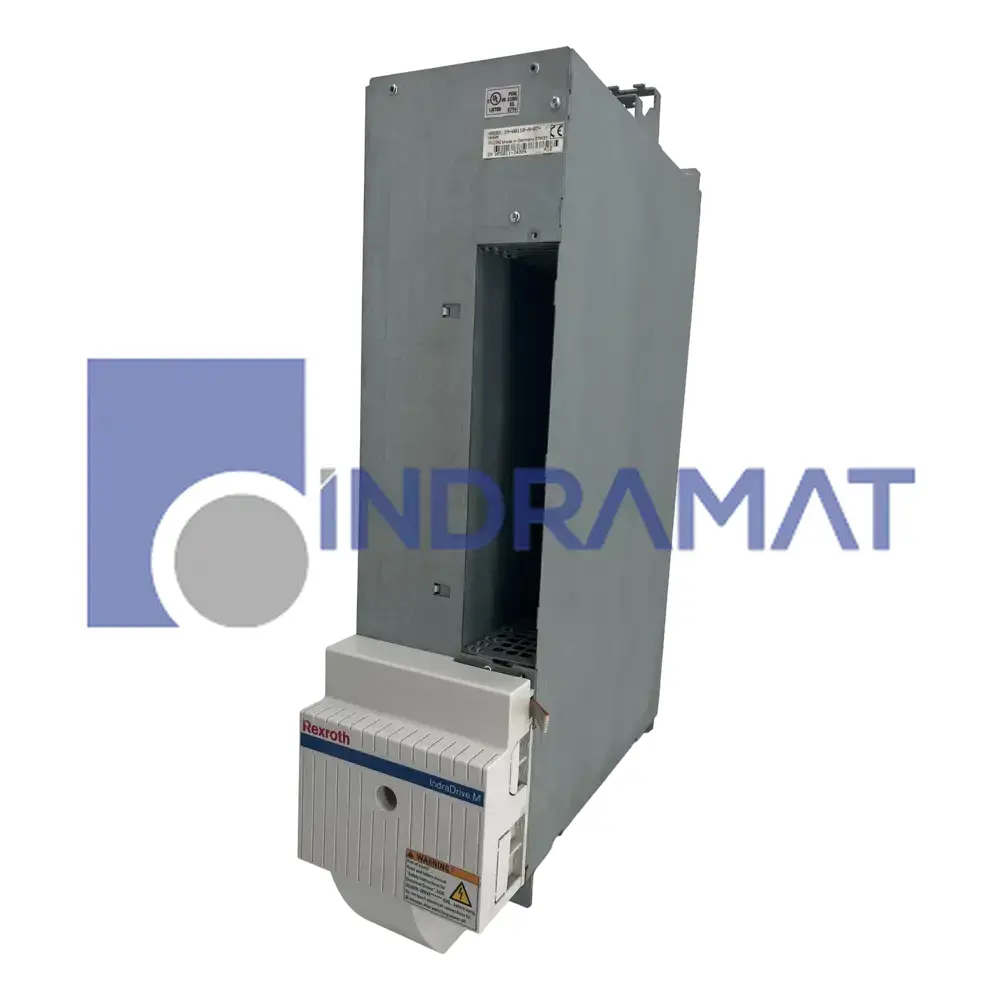
HMS01.1N-W0110-A-07-NNNN
HMS Axis Inverters
Technical Specifications
Cooling Type
Internal Air with Integrated Blower
Design Version
1
Internal Power Supply
Not Equipped
Line Version
1
Nominal DC Bus Voltage
DC 700 V
Product Type
HMS
Protection Class
IP20
Rated Maximum Current
110 A
Frequently Asked Questions
How is continuous current (68.5 A) versus rated maximum current (110 A) relevant for motor matching and duty cycle?
Continuous current is what the inverter can supply indefinitely without exceeding thermal limits; rated maximum is a short-term (peak) current, useful for acceleration or overloads but only for limited duration. A motor and load profile must be chosen so peaks do not overheat the drive, and cooling/ventilation must accommodate those peaks.
What is the significance of having both SERCOS and EtherCAT interfaces on this inverter?
Dual interfaces allow flexible integration in different automation architectures: SERCOS for deterministic, synchronized motion control in machine axes, and EtherCAT for high-speed, distributed control with easier wiring and cost. Firmware/latency constraints differ; using either requires good attention to cabling, termination, and network topology to maintain performance and jitter.
How does the optional Safe Torque Off (STO) feature impact safety certification and machine integration?
STO allows the inverter to disable torque generation (motor power) in a certified safety-manner (usually SIL2/PL d or higher), simplifying safety circuit design for emergency stops or maintenance. To use STO properly, it must be wired into safety circuit hardware, and the module must be compatible with the system’s safety standards and validated firmware.
What encoder compatibility and feedback considerations are relevant for precise motor control using this inverter?
The HMS series supports “multi-encoder interface,” meaning it can handle various encoder types (incremental, absolute, multi-turn, etc.), allowing precise speed/position control and diagnostics; but correct wiring, shielding, grounding, and configuration of feedback parameters (counts/rev, resolution, latency) are critical for loop stability.
How does the switching frequency / output frequency trade-off affect motor heating and control precision?
Higher switching frequencies permit smoother output waveform and reduced torque ripple, improving precision and acoustic noise—but increase switching losses in the inverter and possibly in the motor, heat generation, and demand on cooling. For applications with continuous high load, staying at moderate switching frequencies or improving cooling (or choosing a larger inverter) gives better reliability.
Common Misspellings
HMS 01.1N-W0110-A-07-NNNN
HMS01-1N-W0110-A-07-NNNN
HMS011NW0110A07NNNN
HMS1.1N-W0110-A-07-NNNN
HMSO1.1N-W0110-A-07-NNNN
HMS01 1N W0110 A 07 NNNN
hms01.1n-w0110-a-07-nnnn
Internal Product Review
The Bosch Rexroth Indramat HMS01.1N-W0110-A-07-NNNN HMS Axis Inverter is designed for industrial automation with a 700 V DC bus voltage and 68.5 A continuous current. It supports SERCOS and EtherCAT interfaces, making it suitable for applications in robotics and material handling. The controller also features an optional Safe Torque Off (STO) for enhanced safety and operates efficiently up to 40°C.


Shipping & Payment Options








Warranty

Repair
 We offer a repair service for the HMS01.1N-W0110-A-07-NNNN.
 Want to