MDD025A-N-100-N2G-040FB1
MDD Synchronous Motors
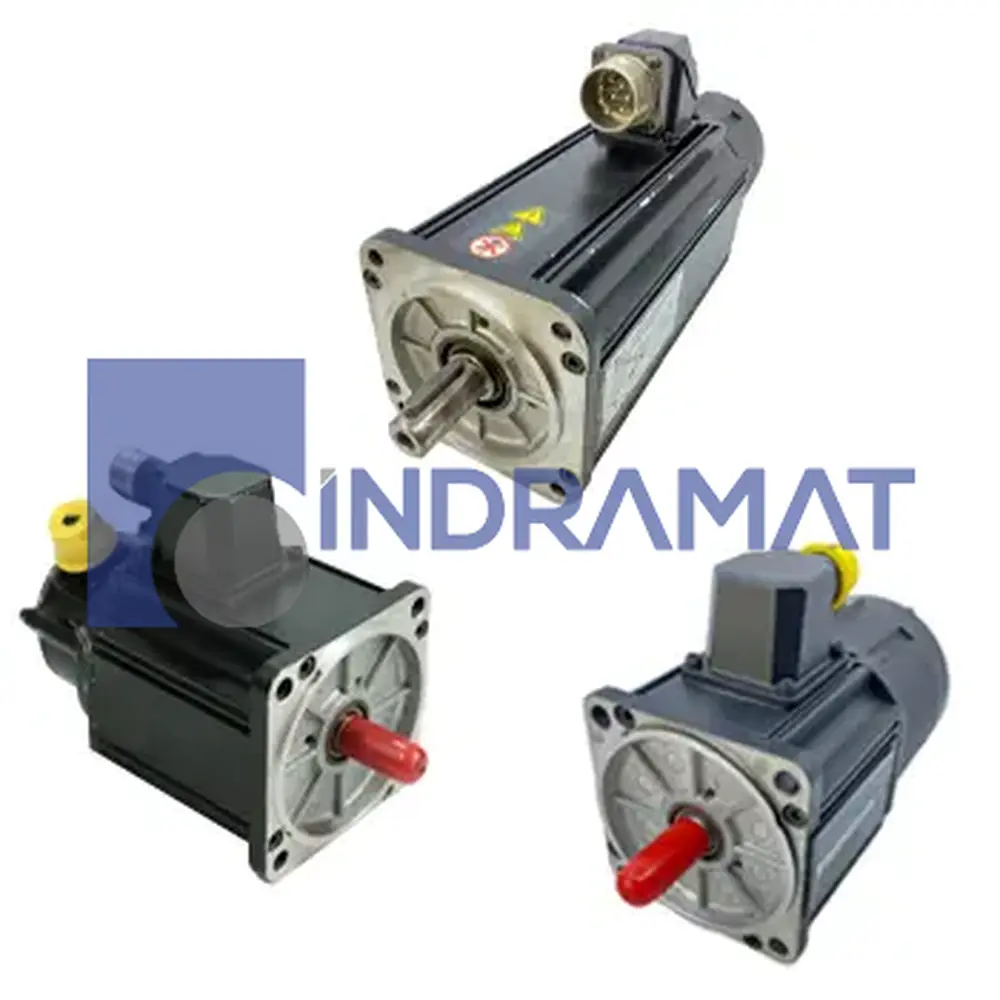
Technical Specifications
Balancing
Standard
Holding Brake
With blocking brake
Holding Brake Torque
1.0 Nm
Centering Diameter
40 mm
Housing
Standard
Motor Feedback
Resolver feedback
Continuous Torque at Standstill
0.33 Nm
Motor Length Code
A
Motor Size
025
Nominal Speed
10000 min⁻¹
Shaft Seal
Without shaft seal
Shaft Type
Plain shaft
Connection Direction
Side B
Connection Type
Connector
Product Type
Motor for digital drive controllers
Shaft End
Standard (without side B shaft end)
Frequently Asked Questions
What are the trade-offs of a continuous standstill torque of ~0.33 Nm for robotics or semiconductor tooling?
At standstill this torque limits how large the static load or moment the motor can hold without slipping; in robotics it means the payload or lever arm must be sized so that the torque requirement stays below ~0.33 Nm. For semiconductor or pick-and-place use, gear reduction or mechanical advantage may be needed if drum loads or high inertia are involved to avoid stall.
How does the blocking (holding) brake with 1.0 Nm holding torque affect safety and power consumption when the motor is shut off?
The brake provides safety by physically preventing motion when power is removed; however it may draw standby current if it is an active brake, so designers must verify the brake’s coil spec and whether an external supply must stay energized. Also, thermal isolation or heat dissipation around the brake should be considered if frequent engages/disengages occur, to avoid overheating.
What are the implications of using resolver feedback rather than a digital encoder in closed-loop control at high rpm?
Resolvers offer better robustness against heat, vibration, dust and electromagnetic interference and survive harsher environments; however, the analog signals need a resolver-to-digital converter (RDC) whose bandwidth, latency, and signal-noise characteristics impose limits on control loop speed and precision. At high rpm, phase lag and excitation frequency constraints of the resolver and its converter must be accounted for to maintain stable speed and torque control.
How does nominal speed of 10,000 rpm impact bearing selection, cooling, and vibration issues?
High rpm demands high-speed rated bearings with minimal friction and good lubrication; unbalanced rotor or misaligned shaft connectors or mountings can excite vibration modes, so balancing is critical. Cooling (air or external) must be enough to dissipate I²R losses, windage, and frictional heating, since losses scale non-linearly with speed.
Considering product code “MDD025A-N-100-N2G-040FB1” by Bosch Rexroth, what should I check for correct mounting and shaft alignment?
You should check centering diameter (40 mm in this case), side (B-side) connector orientation, shaft type (plain shaft), and make sure the motor’s mounting surfaces are flat and within tolerance so that the plain shaft does not suffer misalignment; coupling or connector orientation (side B) must match the machine’s layout. Also verify that any connector clearance and cable routing avoid stress on the connector during vibration or movement.
Common Misspellings
MDD-025A-N-100-N2G-040FB1
MDD025A N 100 N2G 040FB1
MDD025A-N-100-N2G-040-FB1
MDD025AN100N2G040FB1
MDD25A-N-100-N2G-040FB1
MDDO25A-N-100-N2G-040FB1
MDDO25A-N-1OO-N2G-O4OFB1
Internal Product Review
The MDD025A-N-100-N2G-040FB1 motor by Bosch Rexroth delivers a nominal speed of 10,000 min⁻¹ and 0.33 Nm continuous torque. It features resolver feedback, a 1.0 Nm holding brake, and a plain shaft with connector on side B. This motor is ideal for use in robotics, electronics manufacturing, and semiconductor equipment.


Shipping & Payment Options








Warranty

Repair
 We offer a repair service for the MDD025A-N-100-N2G-040FB1.
 Want to