MDD025A-N-100-N2G-040FR0
MDD Synchronous Motors
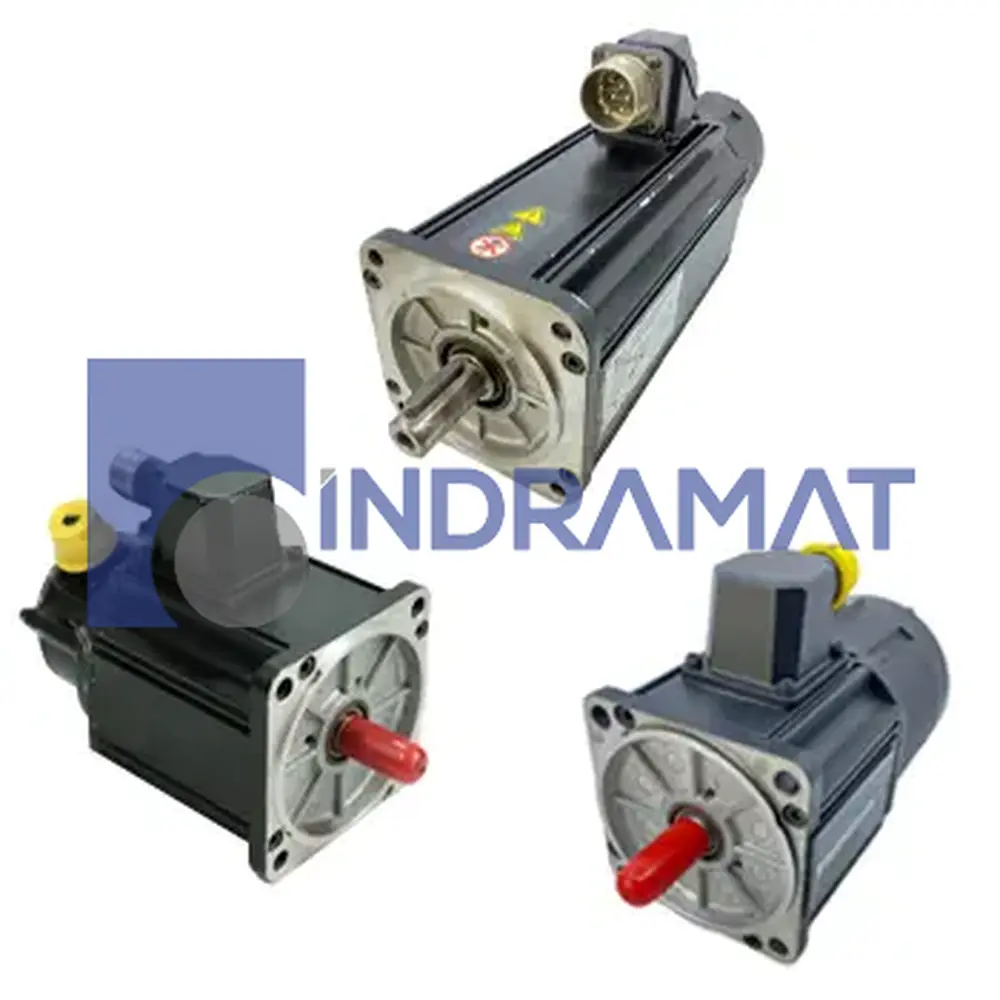
Technical Specifications
Balancing
Standard
Holding Brake
Without blocking brake
Centering Diameter
40 mm
Housing
Standard
Motor Feedback
Resolver feedback
Continuous Torque at Standstill
0.33 Nm
Motor Length Code
A
Motor Size
025
Nominal Speed
10000 min⁻¹
Shaft Seal
Without shaft seal
Shaft Type
Plain shaft
Connection Direction
Right
Connection Type
Connector
Product Type
Motor for digital drive controllers
Shaft End
Standard (without side B shaft end)
Frequently Asked Questions
How does the continuous torque at standstill (0.33 Nm) affect the motor’s ability to handle load inertia and acceleration?
A standstill torque of 0.33 Nm means the motor can resist or start loads without slipping under that torque, but accelerating larger inertia will require higher peak torques above that. The torque-to-inertia ratio and drive current capability become critical when demanding fast start-stop or high dynamic motion.
What are the installation considerations with a plain shaft and no shaft seal?
A plain shaft with no seal requires careful protection against contamination (dust, moisture) especially where ingress may damage bearings or coupling interfaces; shaft coupling alignment is more critical. For hostile environments, additional sealing or using protective boots or covers may be needed to maintain reliability.
How does the centering diameter of 40 mm affect integration into mechanical assemblies and coupling selection?
A 40 mm centering diameter defines the interface for mounting flanges or couplings; mis-match here can introduce eccentricity leading to vibration or uneven load on bearings. Proper matching and concentricity tolerance are essential to avoid introducing mechanical imbalance, especially at high speed.
What are the performance trade-offs of standard balancing instead of high-precision or special balancing?
Standard balancing is good for general use but may allow more vibration at high speed compared to high-precision balancing, which reduces rotor imbalance and associated fatigue. The trade-off is cost vs. vibration amplitude; in robotics or semiconductor tools where vibration tolerance is tight, spec’ing higher balancing may be justified.
Can this motor deliver sufficient torque at higher speeds for sealing or cutting tools, given the 0.33 Nm standstill torque?
While standstill torque is useful for initial holding or full-stop tasks, torque available at higher speeds typically drops due to back-EMF and thermal limits. For operations like cutting or sealing, you must check the motor’s torque vs speed curve; if required torque at speed is above available output, you either need gearing or a higher-torque motor.
Common Misspellings
MDD-025A-N-100-N2G-040FR0
MDD025A N 100 N2G 040FR0
MDD025A-N-100-N2G-040-FR0
MDD025A-N-100-N2G-040-FRO
MDD025A-N-100-N2G-040FRO
MDD025AN100N2G040FR0
MDD25A-N-100-N2G-040FR0
MDDO25A-N-100-N2G-040FR0
MDDO25A-N-1OO-N2G-O4OFRO
Internal Product Review
The MDD025A-N-100-N2G-040FR0 motor by Bosch Rexroth delivers 0.33 Nm continuous torque with a nominal speed of 10,000 min⁻¹. It features resolver feedback, a plain shaft, and a 40 mm centering diameter, suited for integration with digital drive controllers. This motor is commonly used in semiconductor equipment, robotics, and automated packaging systems.


Shipping & Payment Options








Warranty

Repair
 We offer a repair service for the MDD025A-N-100-N2G-040FR0.
 Want to