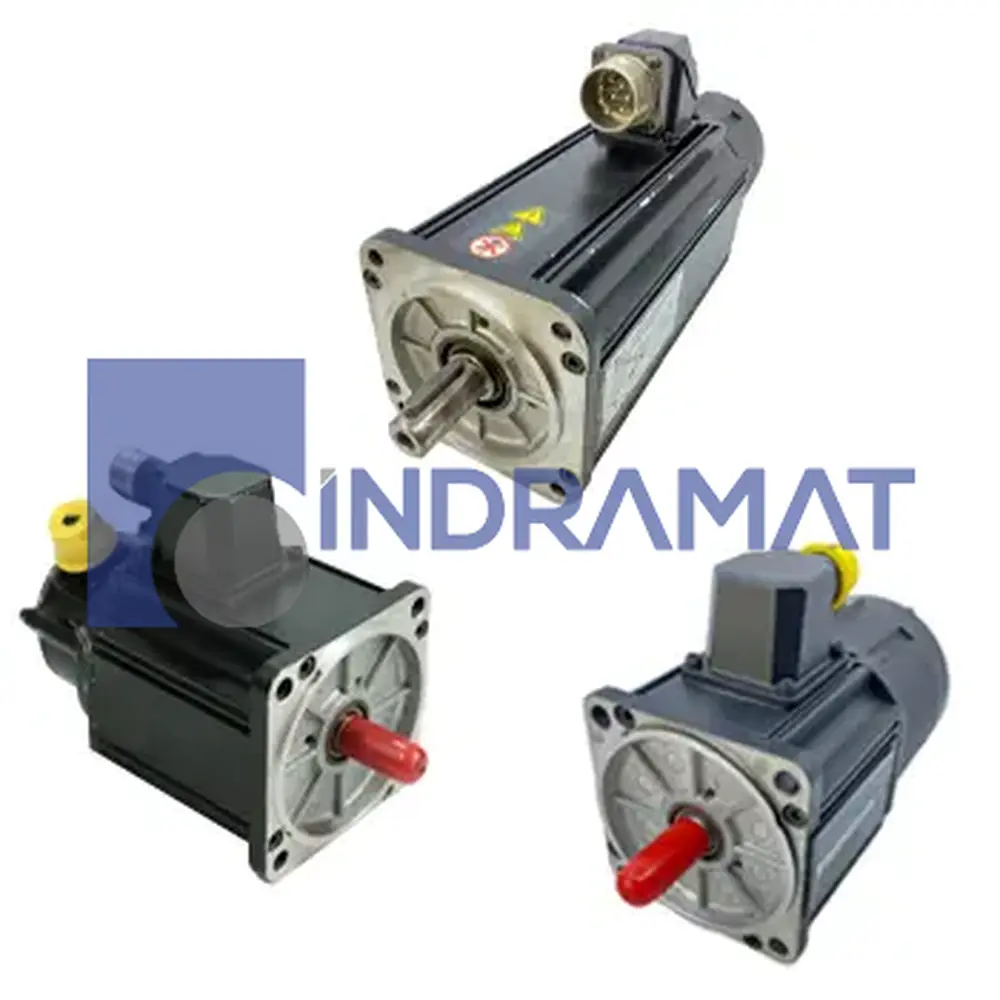
MDD025A-N-100-N2G-040GF1
MDD Synchronous Motors
Technical Specifications
Balancing
Standard
Holding Brake
With blocking brake
Holding Brake Torque
1.0 Nm
Centering Diameter
40 mm
Housing
Standard
Motor Feedback
Resolver feedback
Continuous Torque at Standstill
0.33 Nm
Motor Length Code
A
Motor Size
025
Nominal Speed
10000 min⁻¹
Shaft Seal
With shaft seal
Shaft Type
Plain shaft
Connection Direction
Right
Connection Type
Connecting cable with coupling unit
Product Type
Motor for digital drive controllers
Shaft End
Standard (without side B shaft end)
Frequently Asked Questions
What is the impact of the blocking brake with 1.0 Nm holding torque during emergency stops or power failures?
The brake can hold the motor shaft firmly against applied loads up to about 1.0 Nm without power, preventing unintended motion; but one must ensure external loads (gravity, inertia) do not exceed that torque, or additional mechanical locking may be needed. Also, frequent braking under load may accelerate wear or require heat dissipation considerations in brake design.
How critical is the shaft seal and what are its implications for maintenance in dusty or wet environments?
The shaft seal protects internal bearings and rotor components from ingress of contaminants and moisture, reducing corrosion and wear, but it introduces friction and may limit maximum shaft speeds or increase heat locally. Periodic inspection of the seal and proper lubrication (if applicable) is necessary to maintain performance and avoid leakages or seal failure.
How does a nominal speed of 10,000 min⁻¹ influence the rotor dynamics and mechanical design requirements?
At 10,000 rpm, centrifugal forces, bearing loads, balance, and shaft stiffness become much more critical; even small misalignments or mass imbalance can cause vibrations, noise, and reduced bearing life. The mounting, coupling, and inertial load of what’s attached to the shaft (gear, pulley, etc.) must be designed for inertia matching and support at high speed.
What are the implications of the “plain shaft” design for coupling, mounting, and torque transmission?
A plain shaft (i.e. smooth, without keyway or spline) yields simpler sealing and fewer stress concentrators, but may require special coupling (e.g. clamp or shrink disk) to transmit torque without slip. It also limits torque transfer compared to keyed or splined shafts, so the mechanical interface must be capable of providing enough friction or clamping force.
How does “standard balancing” affect vibration and maximum usable speed compared to “precision balancing”?
Standard balance is adequate for many applications but may allow higher vibration amplitudes at high rpm or under dynamic load changes; precision balancing reduces vibration, enabling smoother high-speed operation, less bearing wear, and lower noise. If the motor is used at or near its 10,000 min⁻¹ limit, depending on the load, precision balancing may become necessary.
Common Misspellings
MDD-025A-N-100-N2G-040GF1
MDD025A N 100 N2G 040GF1
MDD025A-N-100-N2G-040-GF1
MDD025AN100N2G040GF1
MDD25A-N-100-N2G-040GF1
MDDO25A-N-100-N2G-040GF1
MDDO25A-N-1OO-N2G-O4OGF1
Internal Product Review
The MDD025A-N-100-N2G-040GF1 motor from Bosch Rexroth offers a nominal speed of 10,000 min⁻¹ and continuous torque of 0.33 Nm, making it suitable for precision control tasks. It features resolver feedback, a 1.0 Nm holding brake, plain shaft, and a sealed housing with right-side cable connection. Commonly used in robotics, printing, and semiconductor equipment, this motor ensures reliable digital drive control in demanding industrial settings.


Shipping & Payment Options








Warranty

Repair
 We offer a repair service for the MDD025A-N-100-N2G-040GF1.
 Want to