MDD025A-N-100-N2K-040MC0
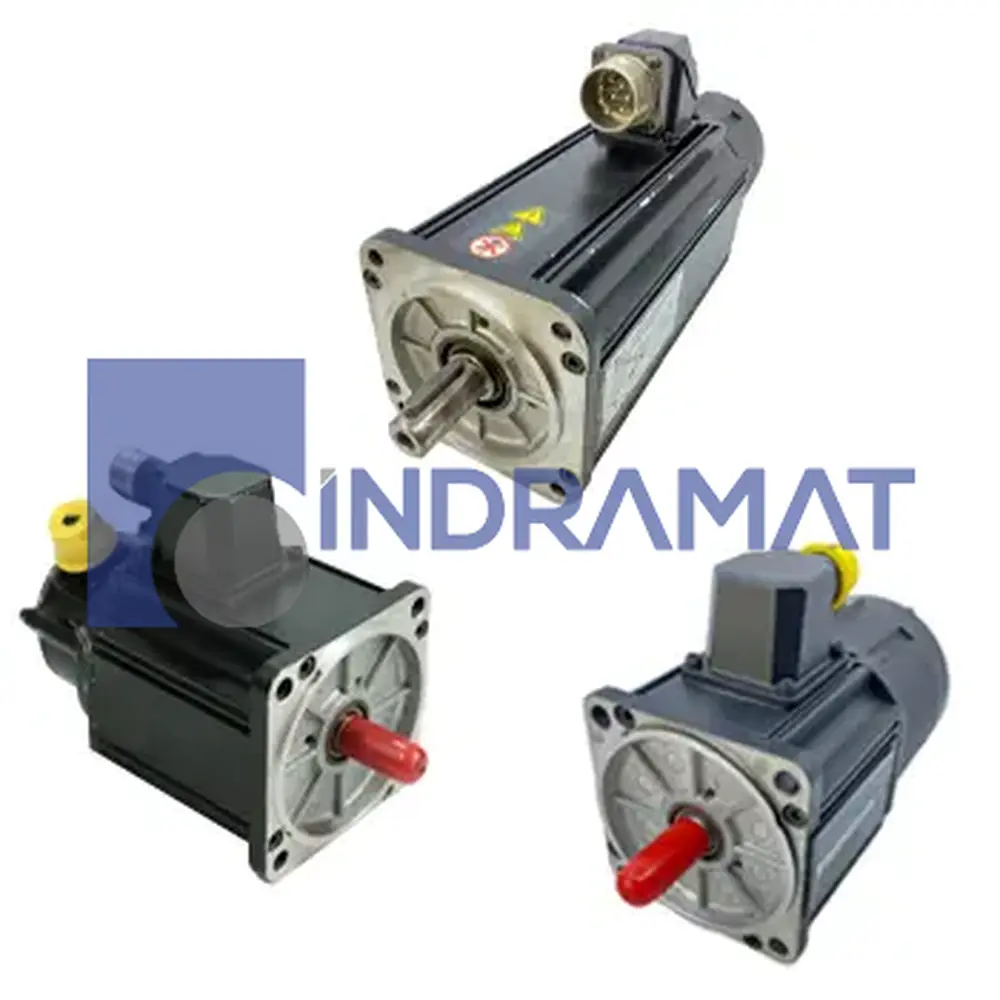
MDD Synchronous Motors
Technical Specifications
Balancing
Standard
Holding Brake
Without blocking brake
Centering Diameter
40 mm
Housing
Standard
Encoder
Integrated absolute encoder
Motor Feedback
Resolver feedback
Continuous Torque at Standstill
0.33 Nm
Motor Length Code
A
Motor Size
025
Nominal Speed
10000 min⁻¹
Shaft Seal
Without shaft seal
Shaft Type
keyway
Connection Direction
Side A
Connection Type
Connecting cable with coupling unit
Product Type
Motor for digital drive controllers
Shaft End
Standard (without side B shaft end)
Frequently Asked Questions
How does a nominal speed of 10,000 min⁻¹ affect cooling and thermal design for continuous operation?
High rotational speed increases friction in bearings and air resistance (windage), so cooling (via convection or forced air) must dissipate that heat to avoid exceeding insulation class limits or degrading lubricant in bearings. Also, torque drops off at higher RPM due to increased losses, so thermal derating curves are essential to maintain reliability over long duty cycles.
What role does the centering diameter (40 mm) and side-A cable connection play in mounting and integration?
The centering diameter ensures that the motor aligns with mating components concentrically, reducing misalignment-induced vibration and bearing load. A cable connection on Side A with coupling unit influences how routing is done; tight cable bends, length, and connector quality affect signal integrity (especially for encoder/resolver signals) and ease of maintenance.
In what ways will the motor’s standard housing (size “standard”, length code A) constrain or benefit compact system designs?
A standard housing and shorter length (length code A) generally reduce footprint and mass, making it easier in space-limited or lightweight robotic arms or lab automation. However, shorter motors may have lower continuous power capacity or less margin for overloading, so careful matching of torque/speed profile to task is necessary.
What are the practical implications of having both resolver feedback and integrated impulse absolute encoder in terms of signal processing and controller requirements?
The resolver requires analog-to-digital conversion and possibly filtering (resolver-to-digital converters) which add latency and requires compatible drive electronics; the absolute encoder output also must be read correctly and synchronized. The controller must support both feedback channels (or at least accept their outputs) and be tuned for combined feedback to avoid oscillations or position error due to phase shifts.
What are the thermal/mechanical limitations imposed by operating the MDD025A-N-100-N2K-040MC0 motor continuously at or near its standstill torque?
Holding the motor at standstill under load means minimal airflow, so heat generated by copper losses (current draw) accumulates, risking insulation damage or overheating unless the motor housing and installation allow sufficient heat dissipation. Mechanically, constant torque at zero speed stresses bearings and shaft keying, so regular maintenance or design for bearing preload is important.
Common Misspellings
MDD-025A-N-100-N2K-040MC0
MDD025A N 100 N2K 040MC0
MDD025A-N-100-N2K-040-MC0
MDD025A-N-100-N2K-040-MCO
MDD025A-N-100-N2K-040MCO
MDD025AN100N2K040MC0
MDD25A-N-100-N2K-040MC0
MDDO25A-N-100-N2K-040MC0
MDDO25A-N-1OO-N2K-O4OMCO
Internal Product Review
The MDD025A-N-100-N2K-040MC0 motor by Bosch Rexroth includes resolver feedback, an integrated absolute encoder, and a keyway shaft. It delivers 0.33 Nm continuous torque at standstill with a nominal speed of 10,000 min⁻¹. This motor is suitable for use in robotics, lab automation, and semiconductor machinery.


Shipping & Payment Options








Warranty

Repair
 We offer a repair service for the MDD025A-N-100-N2K-040MC0.
 Want to