MDD093D-N-040-N2L-130PB1
MDD Synchronous Motors
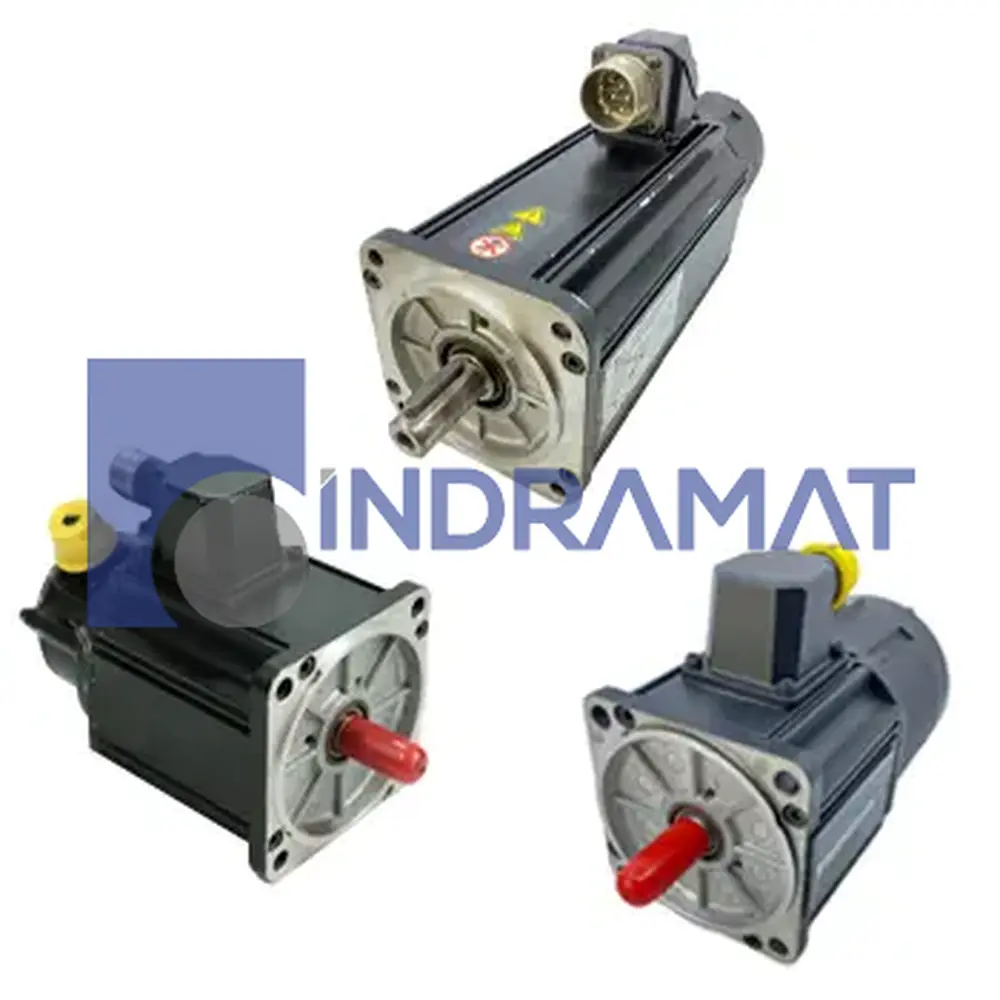
The MDD093D-N-040-N2L-130PB1 from Bosch Rexroth Indramat offers a continuous torque at standstill of 24.0 Nm and a holding brake torque of 11 Nm. Part of the MDD Synchronous Motors series, this motor features digital servo feedback, a centering diameter of 130 mm, and a nominal speed of 4000 min⁻¹.
It includes a blocking brake and standard shaft seal, with a keyway shaft type for secure coupling. The unit has a standard housing and balancing for reliable performance.
Technical Specifications
Balancing
Standard
Holding Brake
With blocking brake
Holding Brake Torque
11 Nm
Centering Diameter
130 mm
Housing
Standard
Motor Feedback
Digital servo feedback (DSF)
Continuous Torque at Standstill
24.0 Nm
Motor Length Code
D
Motor Size
093
Nominal Speed
4000 min⁻¹
Shaft Seal
With shaft seal
Shaft Type
keyway
Connection Direction
Side B
Connection Type
Connector
Product Type
Motor for digital drive controllers
Shaft End
Standard (without side B shaft end)
Frequently Asked Questions
How does the 11 Nm blocking (holding) brake affect dynamic braking and safety?
The holding brake can secure the load when power is off, but because its torque is substantially lower than the motor’s output, it should not be relied on for abrupt emergency stops. For rapid deceleration, the drive must dissipate kinetic energy via regenerative or resistive braking.
What mounting or alignment challenges arise from a 130 mm centering diameter?
A 130 mm centering bore implies a large-mount interface, which demands accurate alignment to avoid radial loads on bearings. Any coupling misalignment will translate into high bearing loads or vibration at high speeds.
How significant is the fact that the shaft uses a keyway coupling in high-dynamic systems?
The keyway ensures a positive mechanical engagement, which is robust for torque transmission, but at high RPMs the key seat must be balanced precisely to avoid added vibration. Also, the key must be dimensioned carefully (per DIN) to prevent fretting.
How do thermal and cooling constraints limit continuous torque at higher speeds?
As speed increases, losses (iron, eddy-current, windage) rise, heating the motor; the manufacturer’s curves typically show decreasing torque capacity at higher speeds. Without forced cooling (fan or blower), continuous torque may need derating above nominal speed.
What load inertia matching considerations should a motion system designer check?
The rotor’s inertia should not be too small relative to load inertia, otherwise the system becomes underdamped or sluggish. A mismatch ratio (load inertia / motor inertia) of roughly 3:1 to 10:1 is often a practical guideline for responsiveness.
Common Misspellings
MDD-093D-N-040-N2L-130PB1
MDD093D N 040 N2L 130PB1
MDD093D-N-040-N2L-130-PB1
MDD093DN040N2L130PB1
MDD93D-N-040-N2L-130PB1
MDDO93D-N-040-N2L-130PB1
MDDO93D-N-O4O-N2L-13OPB1
Internal Product Review
The MDD093D-N-040-N2L-130PB1 motor from Bosch Rexroth features digital servo feedback, a blocking brake with 11 Nm torque, and delivers 24.0 Nm continuous torque at 4000 RPM. It includes a 130 mm centering diameter, keyway shaft, and connector-type side B connection. This motor is suitable for automation tasks in robotics, packaging, and CNC machinery.


Shipping & Payment Options








Warranty

Repair
 We offer a repair service for the MDD093D-N-040-N2L-130PB1.
 Want to