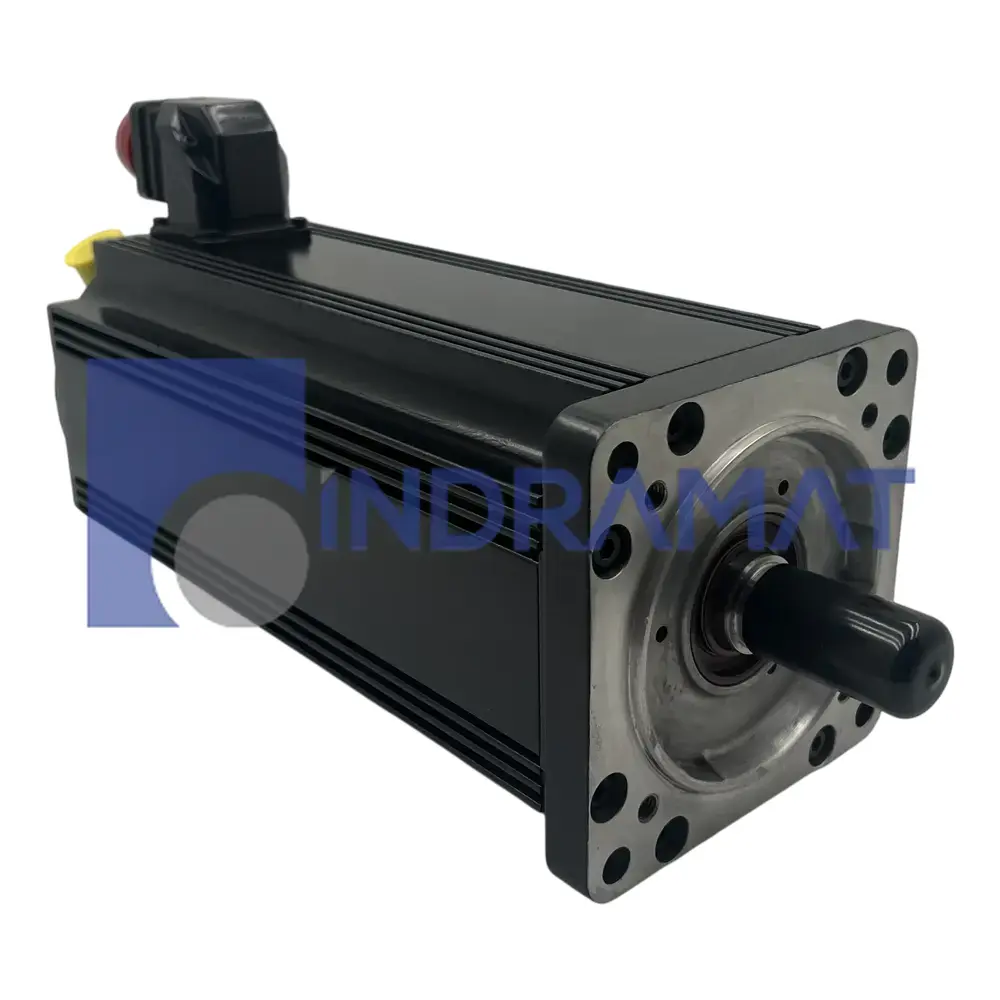
R911250115 (MDD090C-N-030-N2L-110PB2)
MDD Synchronous Motors
Technical Specifications
Feedback Type
Digital Servo feedback
Winding Inductance
2.6mH
Housing color
RAL 9005 black prime coat
Brake type
Electrically actuated release
Bearing type
Fixed and floating bearings
Protection type
Against penetration by extrinsic objects
Housing coating resistance
Chalky buildups, weathering and yellowing
Mounting Flange type
With threads
Frequency range
2Hz to 9Hz
Maximum permissible axial force
Less than the maximum permissible radial force
Storage condition
Dry environment free of dust and shock
Storage temperature
-25°C to 85°C
Shipping method
Well-known logistics partners
Angle feedback connector
Directed towards the B side
Installation requirement
Trained or authorized person.
Frequently Asked Questions
How does the "holding brake with 11.0 Nm" impact emergency stops and safety circuits?
When fitted, the 11.0 Nm holding brake securely locks the shaft under power-off or deceleration, allowing safe stops and preventing drift; for emergency stops it needs sufficient braking force margin above load torque. However, brakes add inertia and require energy to release, so control logic and brake drive circuits must accommodate this.
How critical is the centering diameter (110 mm) for mechanical integration?
The 110 mm centering diameter determines alignment precision with mating components (flanges, gearboxes, bearings); mismatches here can cause misalignment, vibration, and early bearing or coupling failure. Proper mounting surfaces and tolerances are needed to exploit motor precision and maintain long life.
What are the implications of using a keyway shaft with shaft seal in terms of torque transmission and maintenance?
The keyway allows positive torque transfer without slippage under heavy loads, but it can introduce stress concentrations that require careful design of key size, fit, and lubrication. The shaft seal protects against ingress of contaminants, which is important for maintaining bearing and seal life especially in harsh or dirty environments.
How does nominal speed (3000 min⁻¹) relate to usable speed range and torque fall-off?
Nominal speed defines the speed at which rated load can continuously be used; beyond that, torque typically falls off because of limitations in heat dissipation and back EMF. In applications needing higher speed, derating or cooling enhancements are necessary; for frequent changes in speed the inertia and drive capability also matter.
Why are factors like winding resistance, inductance, and current limits important for dynamic performance?
Winding resistance impacts I²R losses and heating, inductance affects how fast current (thus torque) can change (affecting acceleration and response), and current limits govern both peak torque and protection against overcurrent. For high acceleration or load change applications, low inductance and robust current provisioning (drive capable) are essential.
Common Misspellings
MDD-090C-N-030-N2L-110PB2
MDD090C N 030 N2L 110PB2
MDD090C-N-030-N2L-110-PB2
MDD090CN030N2L110PB2
MDD90C-N-030-N2L-110PB2
MDDO90C-N-030-N2L-110PB2
MDDO9OC-N-O3O-N2L-11OPB2
mdd090c-n-030-n2l-110pb2
Internal Product Review
The MDD090C-N-030-N2L-110PB2 motor from Bosch Rexroth is designed for use in CNC machines, robotics, and packaging equipment. It features a continuous torque of 10.4 Nm, a nominal speed of 3000 min⁻¹, and an 11.0 Nm holding brake. The motor includes digital servo feedback and a keyway shaft.


Shipping & Payment Options








Warranty

Repair
 We offer a repair service for the MDD090C-N-030-N2L-110PB2.
 Want to