MSK100A-0200-NN-S1-BG0-NNNN
MSK IndraDyn S Synchronous Motors
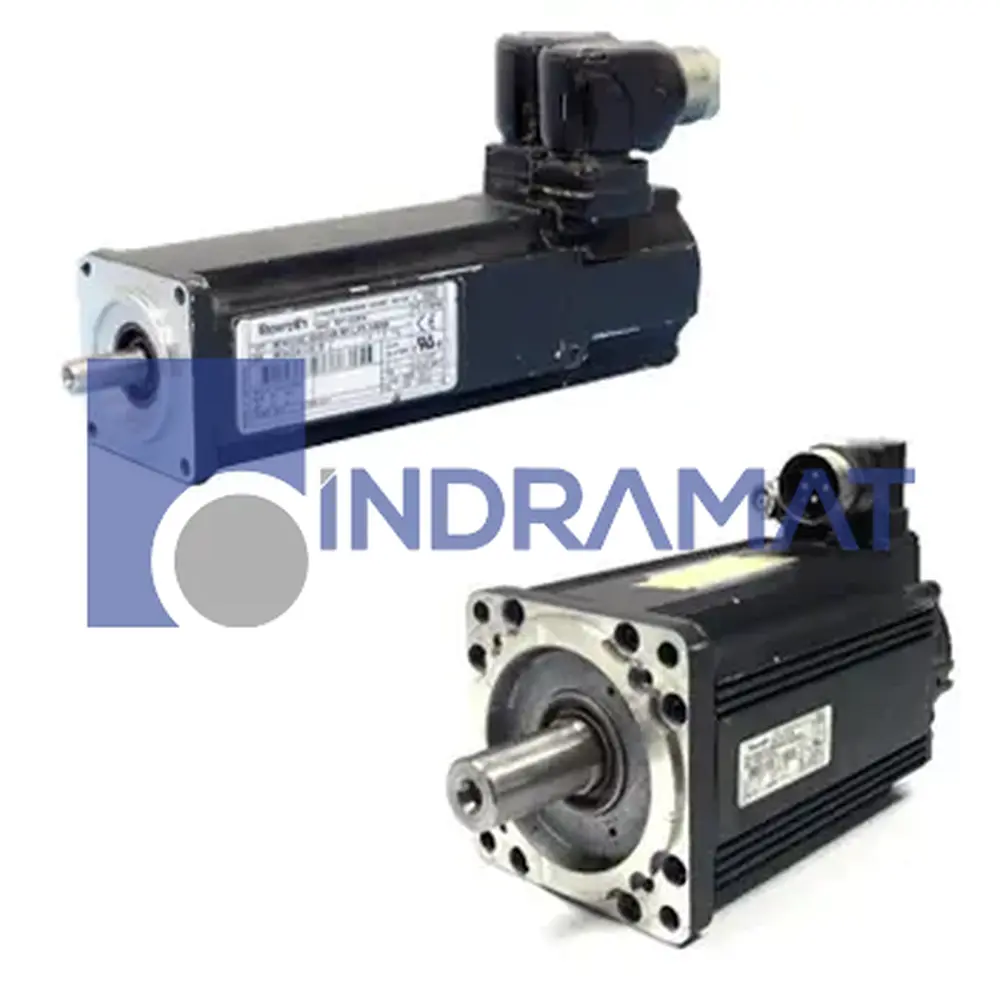
The MSK100A-0200-NN-S1-BG0-NNNN from Bosch Rexroth Indramat has a motor size of 100 and a motor length of A. Part of the MSK IndraDyn S Synchronous Motors, it features natural convection cooling and an optical encoder technology. The power connector is B-Side, it uses a Hiperface encoder interface with 128 signal periods, and serves as an IndraDyn S synchronous servomotor.
It delivers a continuous current at standstill of 10.4 A and a continuous torque of 17.0 Nm while supporting a maximum current of 41.4 A. The maximum torque reaches 54.0 Nm and it comes without a holding brake. The winding inductivity is 13,900 mH and the shaft type is plain shaft.
Technical Specifications
Cooling
Natural convection
Power Connector
B-Side
Encoder Technology
Optical
Encoder Turn Type
Singleturn
Encoder Interface
Hiperface
Encoder Resolution
128 signal periods
Motor Length
A
Motor Size
100
Holding Brake
Without holding brake
Design
Standard
Product Type
IndraDyn S Synchronous Servomotor
Shaft Type
Plain shaft
Rated Speed Code
0200
Continuous Current at Standstill 100 K
10.4 A
Continuous Torque at Standstill 100 K
17.0 Nm
Maximum Current
41.4 A
Maximum Torque
54.0 Nm
Winding Inductivity
13,900 mH
Frequently Asked Questions
What does the single-turn Hiperface encoder (128 periods) contribute to positioning on the MSK100A-0200-NN-S1-BG0-NNNN?
The Hiperface provides analog sine/cos feedback plus RS-485 digital data for enabling the drive to interpolate 128 periods per rev into fine position increments. It improves loop stiffness and smooth velocity control without additional external transducers.
How does natural-convection cooling in MSK100A-0200-NN-S1-BG0-NNNN influence mounting and duty cycle?
The natural convection relies on vertical airflow and clearance; keep surrounding components spaced (e.g., ≥100 mm) to avoid thermal recirculation. Its duty ratings assume unobstructed airflow, while constrained cabinets may require derating or forced-air assistance.
Why choose the plain-shaft design, and how is backlash controlled without a keyway?
The plain shaft allows clamp hubs or zero-backlash couplings that transmit torque via frictional fit for minimizing play compared with keyed interfaces. Its proper hub selection and tightening torque preserve concentricity and torsional rigidity under cyclic loads.
How do 17.0 Nm continuous stall torque and thermal class considerations translate to loading the MSK100A-0200-NN-S1-BG0-NNNN?
Its continuous stall torque at 100 K indicates sustainable mechanical output at thermal equilibrium. Its insulation/thermal class (e.g., Class 155 in related MSK100A variants) and cabinet temperature are important, as elevated ambients reduce permissible continuous torque.
How does the winding inductivity (13,900 mH) of MSK100A-0200-NN-S1-BG0-NNNN affect drive dynamics and EMC?
Its higher phase inductance helps filter current ripple and reduces conducted EMI for easing compliance. It increases electrical time constant, so the current loop bandwidth must be tuned appropriately to achieve commanded torque dynamics.
Common Misspellings
MSK100A0200NNS1BG0NNNN
MSK100A 0200 NN S1 BG0 NNNN
MSK-100A-0200-NN-S1-BG0-NNNN
Internal Product Review
The MSK100A-0200-NN-S1-BG0-NNNN is a synchronous servomotor from Bosch Rexroth, featuring natural convection cooling and a plain shaft design. It delivers 17.0 Nm continuous torque and 54.0 Nm peak torque, with a singleturn optical encoder using the Hiperface interface. Commonly used in robotics, printing presses, and packaging machinery, it suits precision-driven applications.


Shipping & Payment Options








Warranty

Repair
 We offer a repair service for the MSK100A-0200-NN-S1-BG0-NNNN.
 Want to