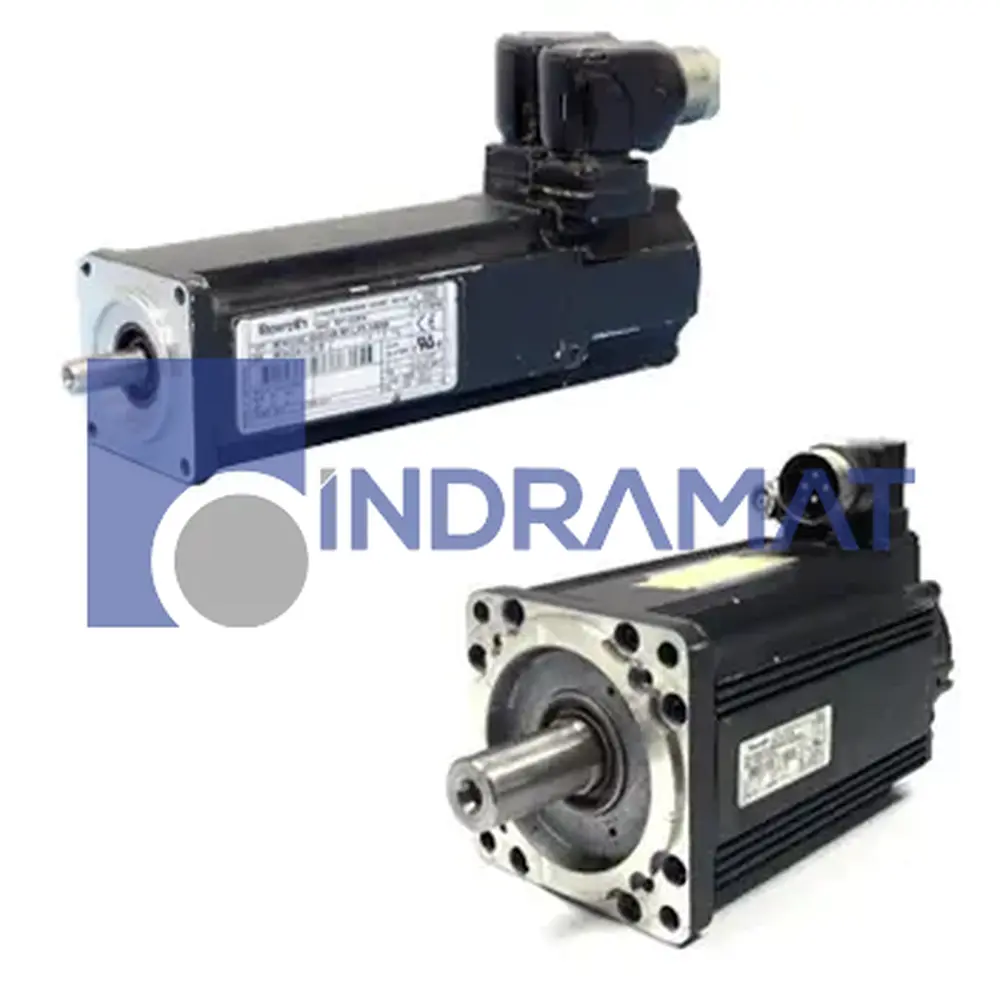
R911322491 (MSK101C-0300-NN-S1-AG0-NNNN)
MSK IndraDyn S Synchronous Motors
Technical Specifications
Windings Code
300
Commissioning Requirement
Inspection for damage before operation
Shutdown Method
Switching off the main switch
Disassembly Protocol
Securing against dropping or moving
Risk Factors
Combustion over surface above 60°C
Environmental Impact
None
Construction Materials
Metals like steel and brass
Running Dependency
Faulty related drive controller prevents operation
Transportation Humidity
75% relative air humidity at 30°C
Storage Climatic Category
1K2 according to EN 60721-3-1 specifications
Secondary Type-Plate Attachment
Required if first one is hidden
Potential Damage Causes
Incorrect high-voltage inspection test
Running Action
Quiet
Power Connector Cap Nut
Hand tightened
Packaging
Rugged for damage-free transportation
Frequently Asked Questions
What encoder scheme does MSK101C-0300-NN-S1-AG0-NNNN use, and how does it influence control quality?
It integrates an optical singleturn Hiperface encoder with 128 signal periods for enabling accurate commutation and velocity/position feedback with low interpolation error and stable phase alignment. It improves tuning bandwidth and minimizes following error in multi-axis motion.
Why specify natural convection cooling instead of forced-air or liquid options on MSK101C-0300-NN-S1-AG0-NNNN?
Its natural convection simplifies installation that reduces ancillary components and avoids blower wiring while maintaining thermal limits for the 36.5 Nm stall torque envelope. It’s adequate for many duty cycles where enclosure airflow or baseplate conduction is available.
How do the 36.5 Nm (100 K) standstill torque and 84.2 A maximum current interact during servo sizing?
The continuous 36.5 Nm rating sets thermal limits for RMS torque, while 84.2 A defines acceleration capability and short-term overload regions. Its proper sizing uses application duty cycles to keep copper/iron losses within thermal steady-state.
How does the plain-shaft, no-brake configuration affect mechanical integration of MSK101C-0300-NN-S1-AG0-NNNN?
The plain shaft simplifies coupling to gearboxes or belt pulleys and removes brake wiring/holding-torque considerations. Its designers should implement external holding/locking or vertical-axis countermeasures if static load retention is required.
What power-connector orientation is provided, and why does it matter for cabinet routing on MSK101C-0300-NN-S1-AG0-NNNN?
The A-side power connector eases cable exit planning in tight machines for separating power/feedback paths to mitigate EMC coupling. It also standardizes M58-style routing seen across MSK101 variants.
Common Misspellings
MSK101C0300NNS1AG0NNNN
MSK101C 0300 NN S1 AG0 NNNN
MSK-101C-0300-NN-S1-AG0-NNNN
Internal Product Review
The Indramat’s MSK101C-0300-NN-S1-AG0-NNNN synchronous servomotor combines Size-101, Length-C mechanics with an optical singleturn Hiperface encoder (128 periods) and A-side power connector. It uses natural-convection cooling and it supports 36.5 Nm stall torque along with 110 Nm peak torque, while draws 84.2 A of maximum current. This motor possess a plain shaft with no brake assembly to support industrial systems.


Shipping & Payment Options








Warranty

Repair
 We offer a repair service for the MSK101C-0300-NN-S1-AG0-NNNN.
 Want to