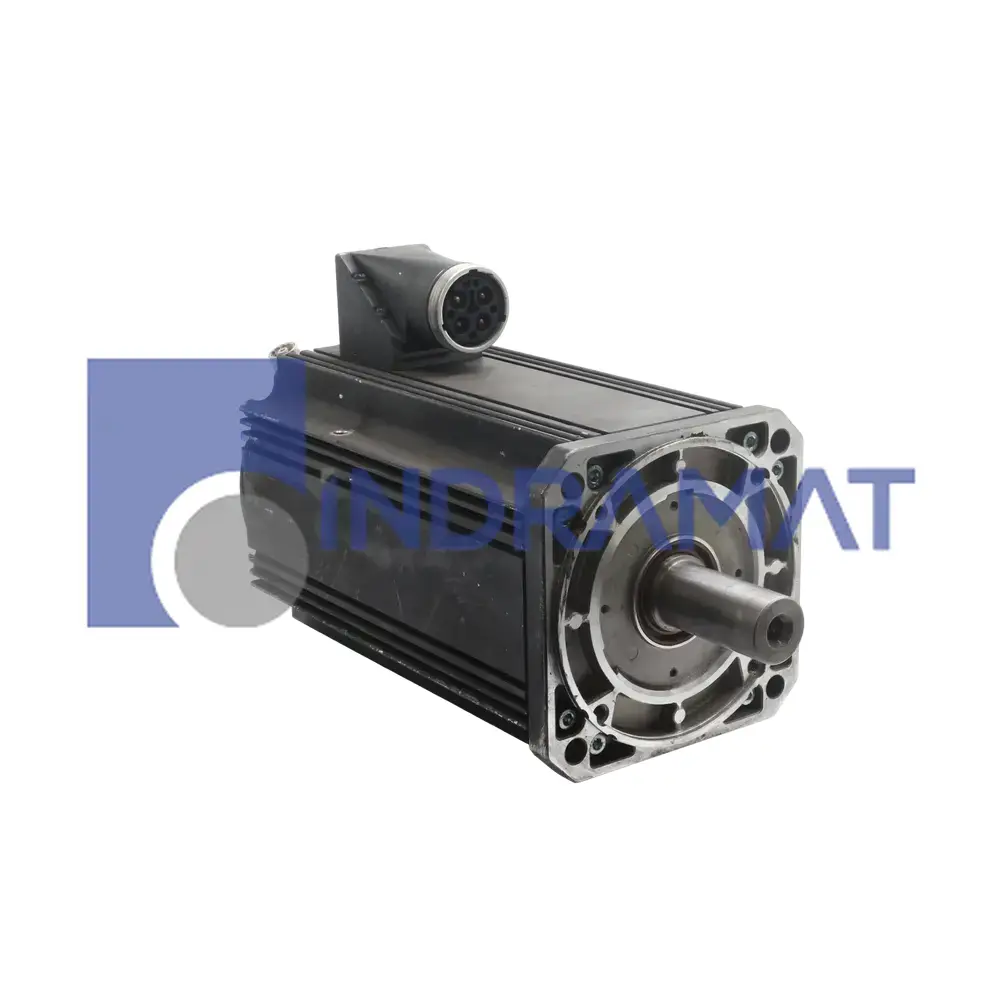
R911336611 (MSK101D-0200-NN-S2-AP2-RNNN)
MSK IndraDyn S Synchronous Motors
Technical Specifications
Type
Synchronous Servo Motor
Cooling method
Natural convection
Temperature Monitoring Systems
KTY84 thermal sensor, Temperature model
Maximum Speed
3400 revolutions per minute
Maximum Torque
160.0Nm
Encoder Type
Single-turn Encoder with EnDat 2.1 interface
Output Shaft Type
Keyway per DIN 6885 with shaft sealing ring
Shaft Sealing Ring Standards
DIN 3760 – design A
Additional Features
Electrically-released holding brake
Frequently Asked Questions
What issues might arise when using the MSK101D-0200-NN-S2-AP2-RNNN in multi-axis B2B systems?
In multi-axis setups, cross-coupling of power supply ripple or vibration can propagate through shared DC bus or mounting structure, so you’ll need decoupling (damping mounts, separate cabling) and proper bus regeneration/energy handling. Also, synchronous updates across axes require your controller to manage latency and feedback loops in large coordinate systems.
How must cable routing be planned given A-side power connection and EnDat encoder wiring?
The A-side connector means power and encoder cables exit from one side, so cable length, bend radius, and shielding must be managed to minimize interference and voltage drop. Keep sensor and power cables separated and twisted/shielded to suppress noise and avoid encoder errors.
In what way does 6,000 mH winding inductance influence dynamic performance?
High inductance filters current ripple and smooths torque, but also slows current loop response—limiting how fast you can aggressively change torque without overshoot. Your servo tuning must accommodate this, especially in high-acceleration moves.
What tradeoffs exist between continuous torque (57 Nm) vs peak torque (160 Nm)?
You can only apply the 160 Nm peak during brief transients before thermal limits constrain you, so your average load must remain near or below the continuous rating. Oversizing or periodic rests may be needed in high-duty cycles to avoid overheating.
How does the 70 Nm holding brake impact startup and shutdown sequencing?
The electrically released brake imposes a slight delay during energize (release) or de-energize (apply) phases, so your control sequence must account for that. If you command motion before the brake is fully released, you risk jerking or stalling; if braking before full stop, torque may overshoot.
Common Misspellings
MSK101D0200NNS2AP2RNNN
MSK101D 0200 NN S2 AP2 RNNN
MSK-101D-0200-NN-S2-AP2-RNNN
Internal Product Review
The MSK101D-0200-NN-S2-AP2-RNNN IndraDyn S Synchronous Servomotor by Bosch Rexroth offers 57.0 Nm continuous torque and 160.0 Nm peak torque with natural convection cooling. It features a singleturn optical encoder (EnDat2.1), 2048 signal periods, and a keyway shaft with an electrically released 70 Nm holding brake. Commonly used in robotics, printing, and CNC machinery, it ensures accurate motion control.


Shipping & Payment Options








Warranty

Repair
 We offer a repair service for the MSK101D-0200-NN-S2-AP2-RNNN.
 Want to