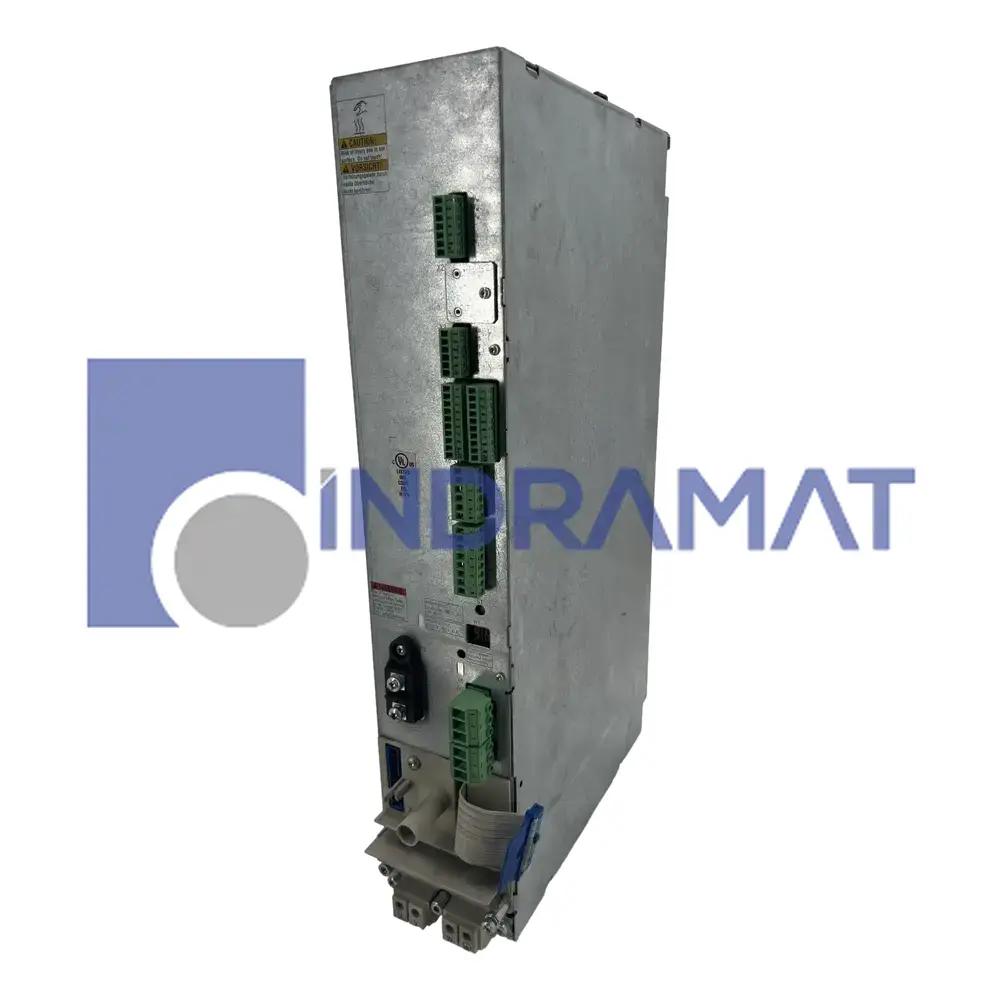
R911190000 (HVE02.2-W018N)
HVE Power Supply Units
Technical Specifications
Operation
Drive controller operation
Usage
Motor operation with 60 kW mechanical power
Mode
Generator mode, Energy dissipation as heat
Combination
Can be combined with CD bus choke GLD
Protection Class
IP 10, Requires control cabinet
Cooling System
Air cooling, Temp should not exceed 45 degrees
Operating Temperature
5 - 45 degrees
Storage Temperature
-30 - 85 degrees
Relative Humidity
95%
Installation Altitude
1000 meters
Input Voltage
3 x 380 - 480 V
Frequency
50/60 Hz
Maximum Power Input
500 VA
Restricted Environments
Under water, extreme temperature fluctuations
Intended Supply
Exclusively for HDS and HDD drive controllers
Additional Requirement
Sensors and actors for control and monitor system
Seller
Indramat USA.
Frequently Asked Questions
What cooling and clearance considerations are needed for reliable operation in a control cabinet?
Although it has an internal blower, the HVE02.2-W018N’s bleeder resistor and other heat-dissipating components require at least ~300 mm above and ~40 mm to the front/sides for airflow. Without adequate clearance or supplemental cabinet ventilation or cooling units, thermal accumulation can reduce life or trigger thermal shutdown.
How does the choice of HVE (unregulated) vs HVR (regulated) series affect regeneration and energy recovery in a robotics or CNC setup?
The HVE series dissipates regenerated energy as heat via a bleeder resistor, whereas HVR units feed it back into the mains, improving energy efficiency. For applications with frequent braking or dynamic motion, using HVR or externally handling regenerated energy can reduce energy loss and cooling burdens.
How many drive axes (servo modules) can be supplied by one HVE02.2-W018N without overloading its control voltage output (300 W)?
The control voltage output must power all auxiliary circuits (sensors, relays, diagnostics) in addition to the drive control electronics. If many axes are used, the sum of their control currents must stay under ~300 W; exceeding that may require a separate auxiliary supply or limiting the number of axes to ensure safe margin.
In what sense is the “continuous bleeder power” relevant, and how should it be considered in system design?
The continuous bleeder power indicates how much regenerated energy the unit can dissipate continuously (as heat) without damage. If your system experiences frequent braking or energy regeneration beyond that capacity, the cabinet will heat up quickly and you may need external heat sinks, ventilation, or even switch to a module/regulation mode that feeds back to mains (i.e. HVR).
What are the power loss factors (base losses vs load-dependent losses) and how do they affect efficiency and cooling demands?
The unit has fixed base (idle) losses plus losses proportional to output load; at full output the load-dependent losses increase. In practice, running continuously near full load increases heat dissipation substantially, which raises cooling demands; for better efficiency, operating at moderate load (e.g. 70-80%) often keeps losses and cooling manageable.
Common Misspellings
HVE 02.2-W018N
HVE O2.2-WO18N
HVE02-2-W018N
HVE022W018N
HVEO2.2-WO18N
HVE02 2 W018N
hve02.2-w018n
HVE02.2W018N
HVE-02.2-W018N
HVE 02.2 W018N
HVE2.2-W018N
Internal Product Review
The Bosch Rexroth Indramat HVE02.2-W018N Power Supply Unit delivers 18 kW of rated power and operates with an input voltage range of 380-480V AC. It’s ideal for industrial applications like CNC drives, robotics, and conveyor systems, offering reliable performance under heavy loads. Its built-in cooling system and compact design ensure efficient operation in tight spaces.


Shipping & Payment Options








Warranty

Repair
 We offer a repair service for the HVE02.2-W018N.
Exchange
 Want to sell your HVE02.2-W018N?