HVE vs. HVR and TVD vs. TVM: Comparing Indramat Power Supply Units
24 April, 2026 | Bosch Rexroth Indramat power supply units, Indramat power supply repair, Indramat power supply replacement, HVE power supply, HVR power supply, TVD power supply module, TVM power supply module, HVE vs HVR, TVD vs TVM, Indramat HVE02.2-W018N, Indramat HVR03.2-W045N/S201, Indramat TVD 1.2-08-03, Indramat TVM 2.4-050-220, Bosch Rexroth legacy power supplies, Indramat DIAX04 power supply,
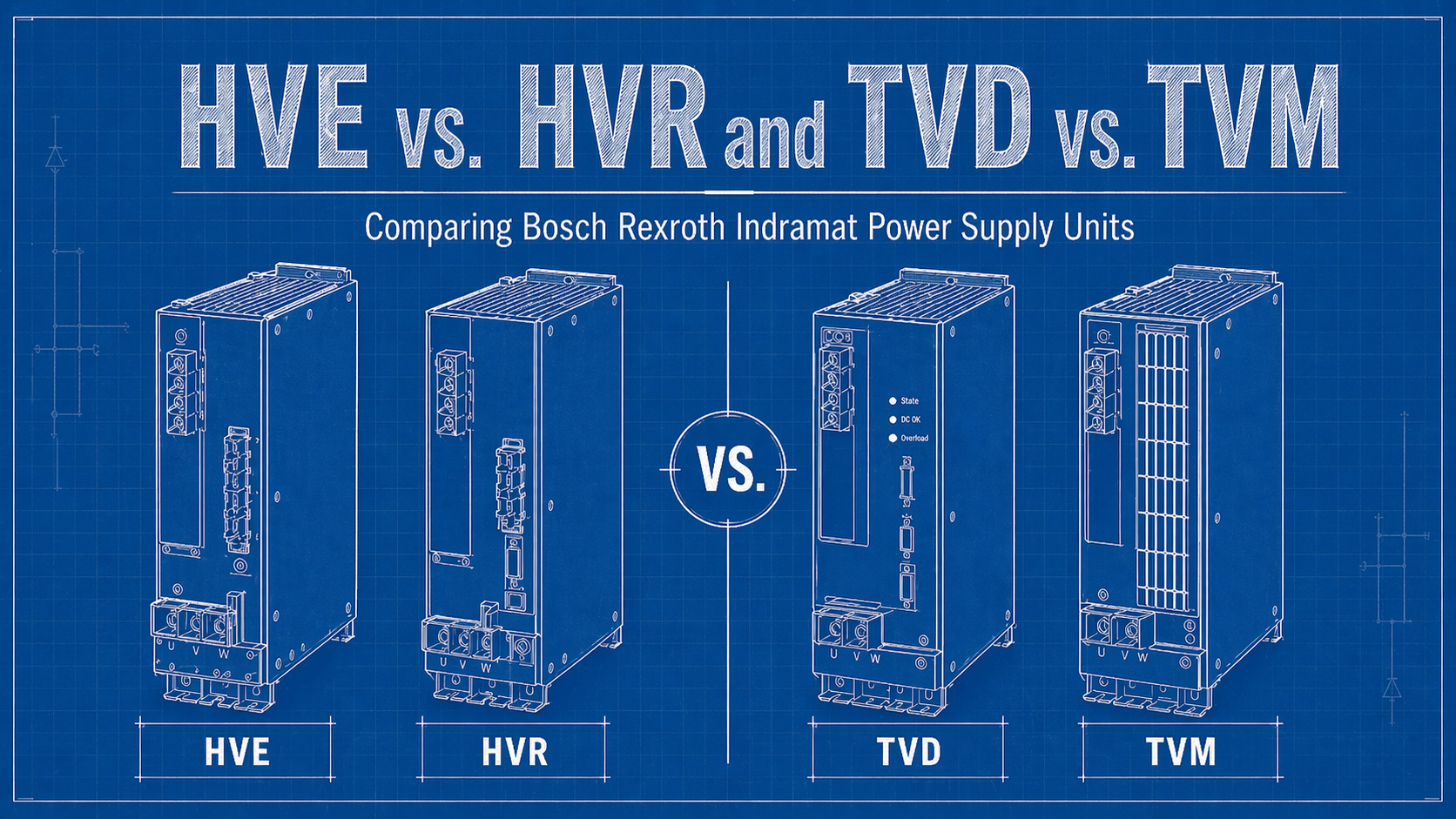
Indramat power supply units remain essential to many legacy motion control systems. The HVE, HVR, TVD, and TVM series all supply DC power to connected servo drives, but they were designed for different system generations, cabinet layouts, and machine demands.
For maintenance teams, engineers, and plant operators working with older Indramat equipment, understanding these differences can make troubleshooting, replacement, and repair decisions much easier. HVE and HVR power supply units are commonly tied to DIAX04 drive systems, while TVD and TVM modules are typically found in earlier Indramat platforms. The key differences come down to DC bus behavior, regenerative capability, power range, braking energy handling, and system integration.
HVE vs. HVR: Unregulated and Regenerative Power Supply Designs
The HVE and HVR power supply families were developed for Indramat DIAX04 systems. In many multi-axis cabinets, one HVE or HVR unit supplies the shared DC bus that feeds several drive controllers. Both series are generally connected to three-phase mains power and convert that input into a high-voltage DC link for the connected servo drives.
The main difference is how each unit manages DC voltage and braking energy.
An HVE power supply provides an unregulated DC bus. It rectifies incoming AC power into DC power without actively stabilizing the output. Because of that, the DC bus voltage changes with the incoming line voltage. This makes the HVE a practical choice for machines where a simple, rugged supply is preferred and precise DC bus regulation is not required.
A common example is the HVE02.2-W018N, which fits applications that need a dependable 18 kW-class supply for a DIAX04 drive system. Larger HVE units, such as the HVE03.2-W030N or HVE04.2-W075N, are better suited for systems with greater power demand but the same basic requirement for an unregulated DC supply. These units are often a good fit for packaging equipment, CNC machinery, printing systems, and general automation lines where braking loads are moderate.
An HVR power supply is the more advanced option because it adds DC bus regulation and regenerative capability. Instead of simply dissipating braking energy as heat, an HVR can return excess energy back to the mains. This is useful in machines with heavy inertia, rapid start-stop cycles, or frequent deceleration.
For example, the HVR03.2-W045N/S201 is a natural fit for larger DIAX04 systems where regulated DC bus performance and regenerative energy handling are important. In a machine with repeated braking cycles, this type of HVR unit can help reduce heat buildup in the cabinet while supporting a more stable DC link for connected drives.
In simpler terms, the HVE is the rugged dissipative option, while the HVR is the regulated and regenerative option. An HVE handles surplus energy through braking or bleeder resistor dissipation. An HVR can return that energy to the electrical supply, making it more efficient in the right application.
HVE vs. HVR Power Supply Comparison
Feature | HVE Power Supply | HVR Power Supply |
Supply Type | Unregulated DC power supply | Regulated, regenerative DC power supply |
DC Bus Behavior | Varies with AC input | Maintains a regulated DC bus |
Braking Energy | Dissipated as heat through resistors | Returned to the mains |
Product Examples | HVE02.2-W018N, HVE03.2-W030N, HVE04.2-W075N | HVR03.2-W045N/S201, HVR02.2-W025N |
Best Fit | Standard multi-axis systems with moderate braking | High-inertia or frequent braking applications |
Maintenance Focus | Capacitors, resistors, and general power section | Fans, capacitors, inverter circuitry, and regeneration section |
TVD vs. TVM: Earlier Indramat Power Supply Modules
Before HVE and HVR units became common in DIAX04 systems, Indramat used TVD and TVM modules in earlier servo drive architectures. These modules also convert AC input into DC power for connected drives, but they differ in power capacity, cabinet design, and typical machine size.
A TVD power supply module is the larger and more modular option. TVD units were used in higher-power multi-axis systems and could support several connected drives from a shared DC bus. They are commonly found in older CNC equipment, printing machinery, packaging systems, and other installations that require a central DC supply for multiple axes.
A unit such as the TVD 1.2-08-03 is a good example of a lower-output TVD module used in multi-axis systems that do not require the higher capacity of a larger supply. For applications with greater continuous power demand, a TVD 1.2-15-03 may be the more appropriate match. Both examples belong to the same general TVD family, but the right choice depends on the machine’s power demand, connected drives, and cabinet configuration.
TVD modules are non-regenerative. When connected motors decelerate and feed energy back into the DC bus, the TVD does not return that energy to the mains. Instead, the excess energy is handled through resistor-based dissipation. This protects the drive system from overvoltage but also means braking energy is converted into heat.
TVD systems often work with separate line-side equipment, including NAM modules. This modular design made sense in larger Indramat cabinets where line connection, pre-charge, filtering, and DC bus support were handled across multiple components.
A TVM power supply module is generally smaller and belongs to an earlier generation of Indramat systems. TVM modules are often used in lower-power machines with fewer axes. Like the TVD, the TVM is non-regenerative and dissipates braking energy as heat.
A model such as the TVM 2.4-050-220-300-W1-115 is a strong example of the kind of compact legacy power supply found in older Indramat-equipped machinery. In applications where the system needs a lower-power DC supply for a smaller group of drives, a TVM can be a better fit than a larger TVD setup. The more self-contained design also made TVM modules practical for compact machines, single-station automation equipment, and early-generation servo systems.
The TVD is best viewed as the higher-power modular supply, while the TVM is the lower-power compact supply. Neither one offers the regenerative functionality associated with HVR units.
TVD vs. TVM Power Supply Comparison
Feature | TVD Power Supply | TVM Power Supply |
Supply Type | Higher-power modular DC supply | Compact legacy DC supply |
Voltage Regulation | Unregulated DC output | Unregulated DC output |
Braking Energy | Dissipated through resistors | Dissipated through internal resistor handling |
Product Examples | ||
Best Fit | Larger multi-axis systems | Smaller systems with fewer axes |
System Design | Often used in larger modular cabinets | Usually more self-contained |
Conclusion: Keep Legacy Indramat Systems Running with the Right Power Supply Support
Indramat HVE, HVR, TVD, and TVM power supplies each serve a specific role in legacy motion control systems. HVE units such as the HVE02.2-W018N, HVE03.2-W030N, and HVE04.2-W075N provide rugged unregulated power for DIAX04 systems. HVR units such as the HVR03.2-W045N/S201 add DC bus regulation and regenerative feedback for machines with heavier braking demands.
For earlier Indramat platforms, TVD modules such as the TVD 1.2-08-03 and TVD 1.2-15-03 support larger multi-axis systems, while TVM modules such as the TVM 2.4-050-220-300-W1-115 are commonly associated with smaller legacy applications.
Understanding these differences helps maintenance teams respond faster when a power supply fails, a machine goes down, or a replacement needs to be sourced. The correct choice depends on the system generation, drive family, total power demand, and whether the machine requires regenerative energy handling.
Indramat USA helps customers source replacement and refurbished Indramat power supply units and supports repair options for legacy equipment. Whether you are working with an HVE, HVR, TVD, or TVM failure, Indramat USA can help identify the right replacement path and keep production moving. Indramat USA is not an authorized Indramat distributor. Use the quote form on Indramat-USA.com or call 1-888-551-3082 for fast assistance. International customers can call 1-919-443-0207.